
Irama visualization
Irama is a central concept in Javanese gamelan music, describing the pace at which the core melodic structure of a piece unfolds, relative to the piece’s rhythmic textures. A piece is typically performed at several different iramas, each one twice as slow as the last. In a slower irama, the melody has more room to expand, and it often takes a more elaborate form: tracing the same overall melodic arcs, but taking more elaborate routes along the way.
After playing in the Brown University gamelan ensemble for several years, and getting a feel for the relationship between iramas as a musician, I was curious how it would look to visualize this relationship. See below for an explanation.
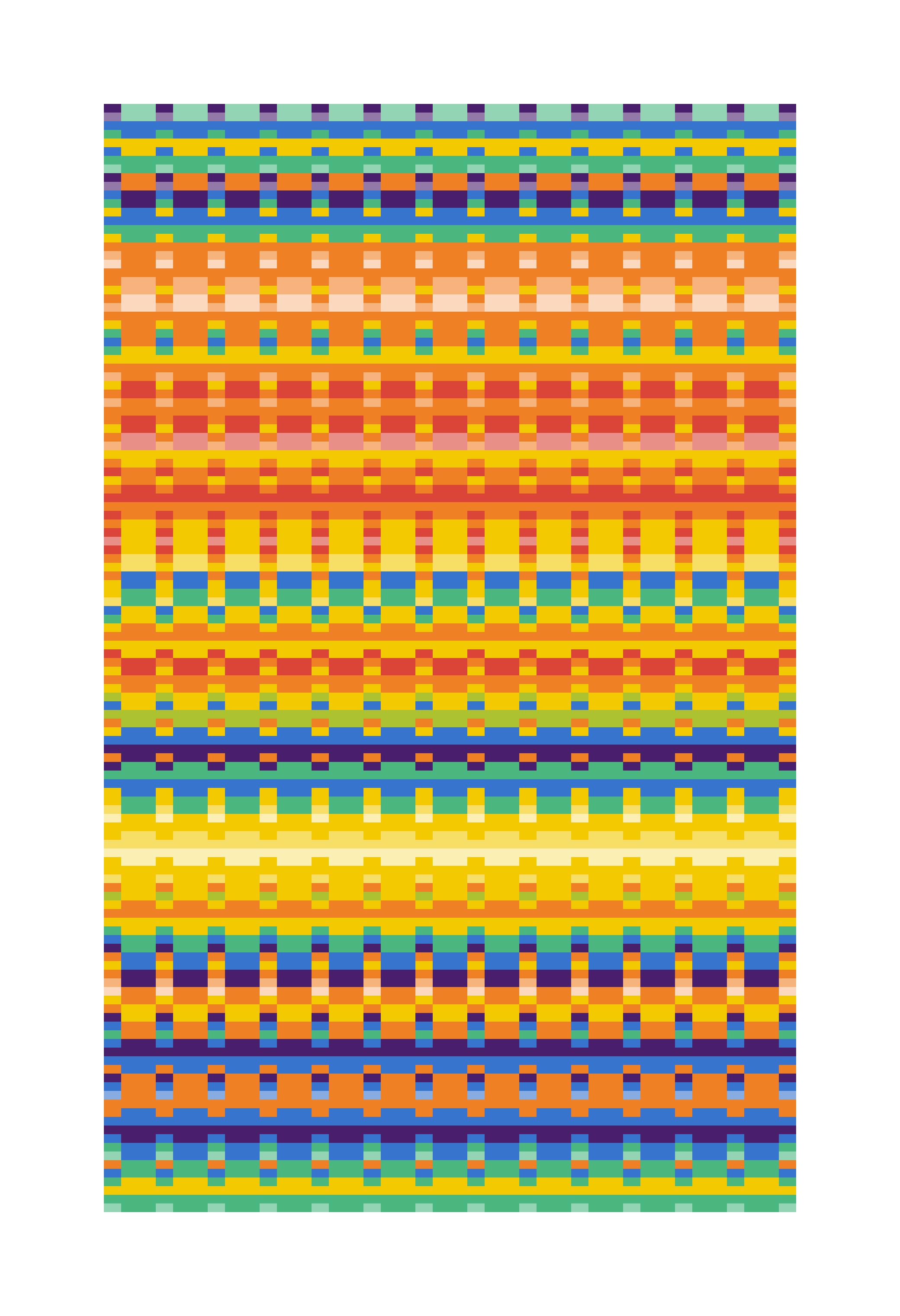
This represents a piece, Ladrang Kembang Setaman, which our instructor Harjito wrote for us. The image is read from top to bottom. The colors (in reverse rainbow order, purple through red) represent the notes of the pélog scale, 1 through 7. The wider bands represent the faster irama tanggung, and the thinner bands represent the slower irama dadi. When a note is held for a beat or two (notated as • below), that is shown by keeping the same hue but fading toward white, as the sound from the strike of the instruments fades.
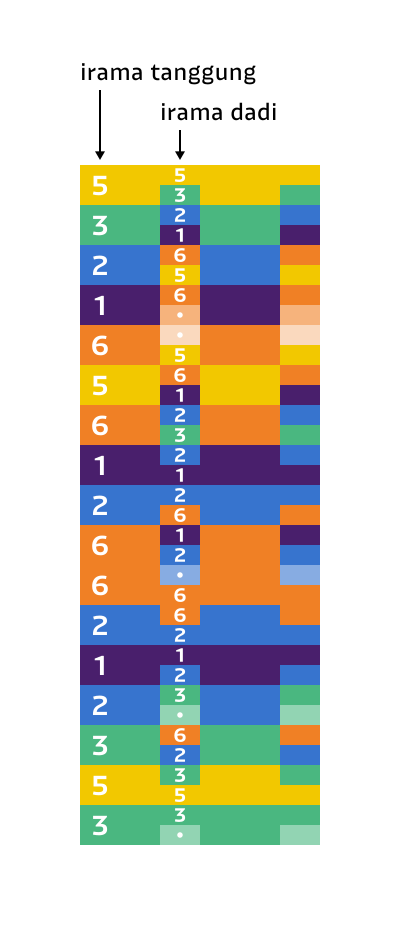
In a performance, the piece is first played in irama tanggung; then it is played in irama dadi, which lasts twice as long. My visualization does not represent this structure: I scaled the two iramas to take the same amount of space (each band represents the same unit of time, even though the dadi bands are half the size), and I layered them on top of each other. This presentation makes it more apparent how the overall arc of the melody is the same across both iramas, as they move through the same progression of color palettes, and certain color progressions appear at both larger and smaller scales.