
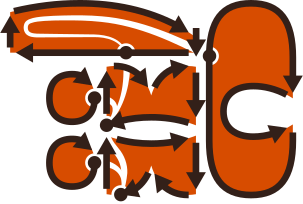
“Hold” written in Contour Code
risograph print, 7×5”

This piece encodes the word “hold” in the sides of the shapes: different sequences of straight, convex, and concave sides represent different letters.
To read a composition in Contour Code, one must determine the right order to read the sides. The diagram and explanation below show how that happens for this piece. (Soon there will also be a complete explanation of the system on the main Contour Code page.)

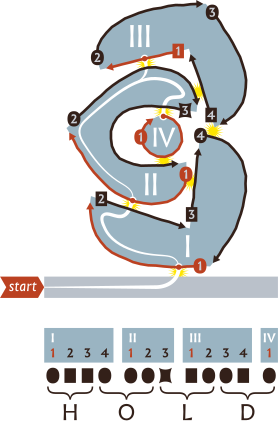
- First the shapes are put in order. This is shown using the white lines and Roman numerals. Each white line traces clockwise around a shape, moving or branching into other shapes whenever it gets close enough (at the yellow stars), as long as the shape is one it hasn’t already entered. Any holes within shapes are dealt with before moving into other shapes.
- Once the shapes are put in order, the sides of each shape are traced, starting from the point where the white line entered the shape. The numbered arrows show this sequence, and the shapes of these labels indicate whether the sides are straight, convex, or concave.
- Below the diagram, all these sides are recorded in sequence. Each group of three sides corresponds to a letter (for example, E is straight–straight–convex).
Word suggested by Alice Jo